
Yogyakarta — Universitas Gadjah Mada (UGM) welcomed a follow-up visit from the delegation of Nanjing University of Aeronautics and Astronautics (NUAA), China, continuing the strategic engagement initiated during the previous official visit. The visit specifically focused on strengthening the International Joint Laboratory on Digi-Medical Engineering and Integrated Measurement Systems, which has been officially established since 2024 as a multinational research hub.
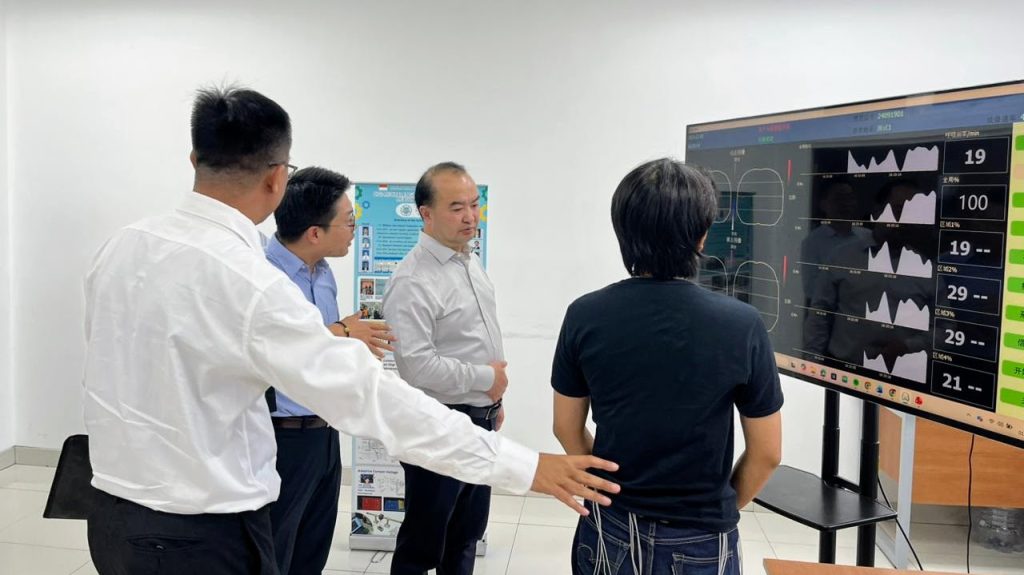
The NUAA delegation was led by Prof. TAO Yong (Vice Chairman of the University Board), accompanied by Prof. KONG Chuiqian (Director of the Academic Affairs Department), Dr. ZHANG Guoquan (Deputy Director of the International Cooperation Office), Dr. ZHANG Lin (Vice Director of the Student Affairs Department), Dr. WU Weiwei(Vice Dean of the College of Civil Aviation), and Prof. JIN Quanyuan (Dean of the London International College). The visit involved UGM’s university leaders, faculty representatives, and the international joint laboratory development team.
The International Joint Laboratory on Digi-Medical Engineering and Integrated Measurement Systems is a collaborative research center involving UGM, NUAA, Xi’an University of Technology (China), and Chiba University (Japan). The laboratory focuses on digital medical engineering, integrated and intelligent measurement systems, advanced sensing, and tomographic measurement technologies, addressing applications in healthcare, energy systems, and industrial monitoring.
The laboratory was developed from a sustained collaboration initiated in 2021 and formalized through MoU and MoAagreements between UGM and NUAA during 2023–2024. Since the pre-launch of the International Joint Laboratory at NUAA in late 2023 and its full operation in 2024, the collaboration has encompassed faculty and student exchanges, guest lectures, visiting professor programs, and joint research activities in integrated measurement systems .
The scientific foundation of the laboratory is supported by long-standing collaborative publications among Dr. Eng. Yosephus Ardean Kurnianto Prayitno (UGM), Assoc. Prof. Bo Sun (Xi’an University of Technology), and Prof. Jiafeng Yao (formerly at NUAA and currently at Jinan University). Their joint work has resulted in multiple Scopus-indexed journal publications and contributions to international conferences, particularly in the fields of industrial and electrical process tomography, integrated measurement systems, and data-driven reconstruction methods .
A key research focus of the International Joint Laboratory is the development of Adaptive Current–Voltage (ACV)-based measurement systems integrated with machine learning to optimize image reconstruction and multiphase flow measurement. This research is highly relevant to both digital medical applications and industrial diagnostics, including complex fluid and pipeline systems .
The follow-up visit by the NUAA Vice-President served to review the laboratory’s initial achievements, align medium-term research roadmaps, and strengthen future collaboration through joint research projects, co-supervised master’s and doctoral programs, and international research funding initiatives. This engagement reinforces the role of the International Joint Laboratory as a sustainable platform for global research collaboration.
This initiative directly contributes to the United Nations Sustainable Development Goals (SDGs), particularly SDG 3 (Good Health and Well-Being), SDG 4 (Quality Education), SDG 9 (Industry, Innovation, and Infrastructure), and SDG 17 (Partnerships for the Goals) through strengthened research capacity, international education, and long-term global partnerships.