
The GNSS practicum was a mandatory academic activity for students of the Applied Bachelor Program in Surveying and Mapping Technology Universitas Gadjah Mada Vocational College (SV UGM). Conducted within the UGM campus on March 4, 5, and 12, 2026, the practicum aimed to provide students with hands-on experience in GNSS operation, data acquisition, and data processing using static, RTK NTRIP, and PPK methods with Trimble R8s equipment. The practicum involved 61 students and was supervised by the course lecturer as part of practice-based learning.
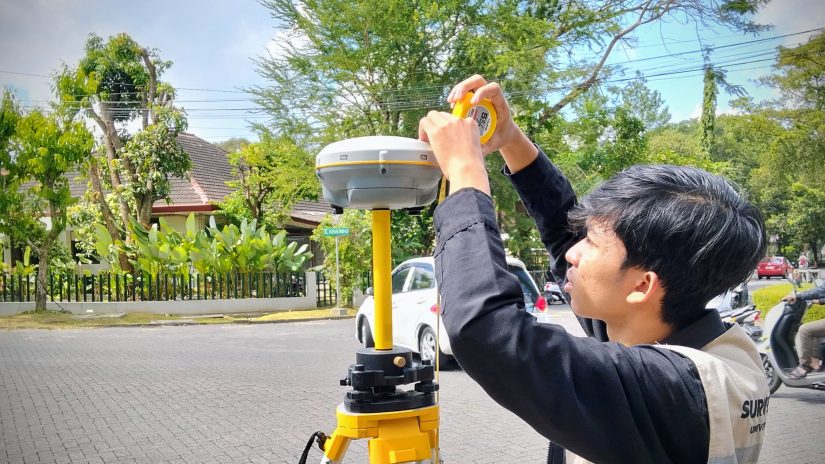
GNSS data processing was carried out using three main methods. The static method involves long-duration observations followed by post-processing to achieve very high accuracy at the millimeter level. Meanwhile, the Real-Time Kinematic (RTK) NTRIP method determines high-accuracy positions in real time using differential corrections from a Continuously Operating Reference Station (CORS) network via the internet (NTRIP), making it highly effective for detailed mapping. The Post-Processing Kinematic (PPK) method is a kinematic approach in which differential corrections are applied after data acquisition through post-processing. This method serves as an alternative when RTK communication is unstable while maintaining an accuracy level comparable to RTK.
All data processing activities were carried out using the Trimble R8s GNSS receiver, a multi-frequency receiver capable of supporting multiple satellite constellations, thereby ensuring the reliability and accuracy of the measurements.
The activity aimed to equip students with competencies in survey planning, instrument operation, and post-processing techniques to obtain high-precision control point coordinates. These skills provide an important foundation for students pursuing careers as professional surveyors.
The practicum was successfully carried out, supported by good weather, the availability of four Trimble R8s units, and a comprehensive methodology. These factors enabled each group to gain sufficient hands-on practice time and successfully collect valid datasets. Overall, the practicum achieved its learning objectives and established a strong foundation in GNSS-related skills.